Selecting the right AI
Make well-founded choices: which AI fits your goals, risks and users? We look at assessment aspects, selection criteria, transparency, and what you need to know before purchasing the AI tool.
Whatever AI-related question, problem or goal your organisation or company has, the right knowledge and expertise around AI across multiple disciplines and sectors is fundamental to success. On this page you will find more information about what an AI consultant is and the themes AISS can support you with. This includes tailored handouts such as checklists, templates and infographics.
Looking for something specific? Get in touch: I support organisations in areas including the commercial sector, healthcare, the public sector and technology, from selection and evaluation to implementation, monitoring and AI literacy.
An AI consultant helps organisations apply AI and related technologies (such as Machine Learning and robotics) in a smart, safe and appropriate way, with a focus on your goals, context and people.
An AI consultant is a specialised consultant in the field of AI who provides support and guidance in all kinds of AI-related situations, questions and problems. The goal is to optimise your potential by making smart and appropriate use of AI and similar technologies. That is why an AI consultant is often seen as a strategic partner who helps companies and organisations navigate the complex, fast-growing world of AI and make the most of it.
During a project, I maintain oversight by bringing together knowledge and expertise, and I make sure all involved parties continue to work together to achieve the intended result. This is essential for successfully integrating AI within an organisation, both in work processes and in workplace culture.
As an AI consultant, I have knowledge and expertise in various fields that are relevant to AI, such as the technical side, laws and regulations, and the application of AI. An important part of my work is keeping knowledge up to date and thinking ahead. In addition, this ensures that I understand the corresponding terminology used in these fields and can select AI-related information that is relevant to a company or organisation and translate it appropriately. In this way, I help make the world of AI manageable, more understandable and applicable for organisations and companies, tailored to employee roles and sector(s).
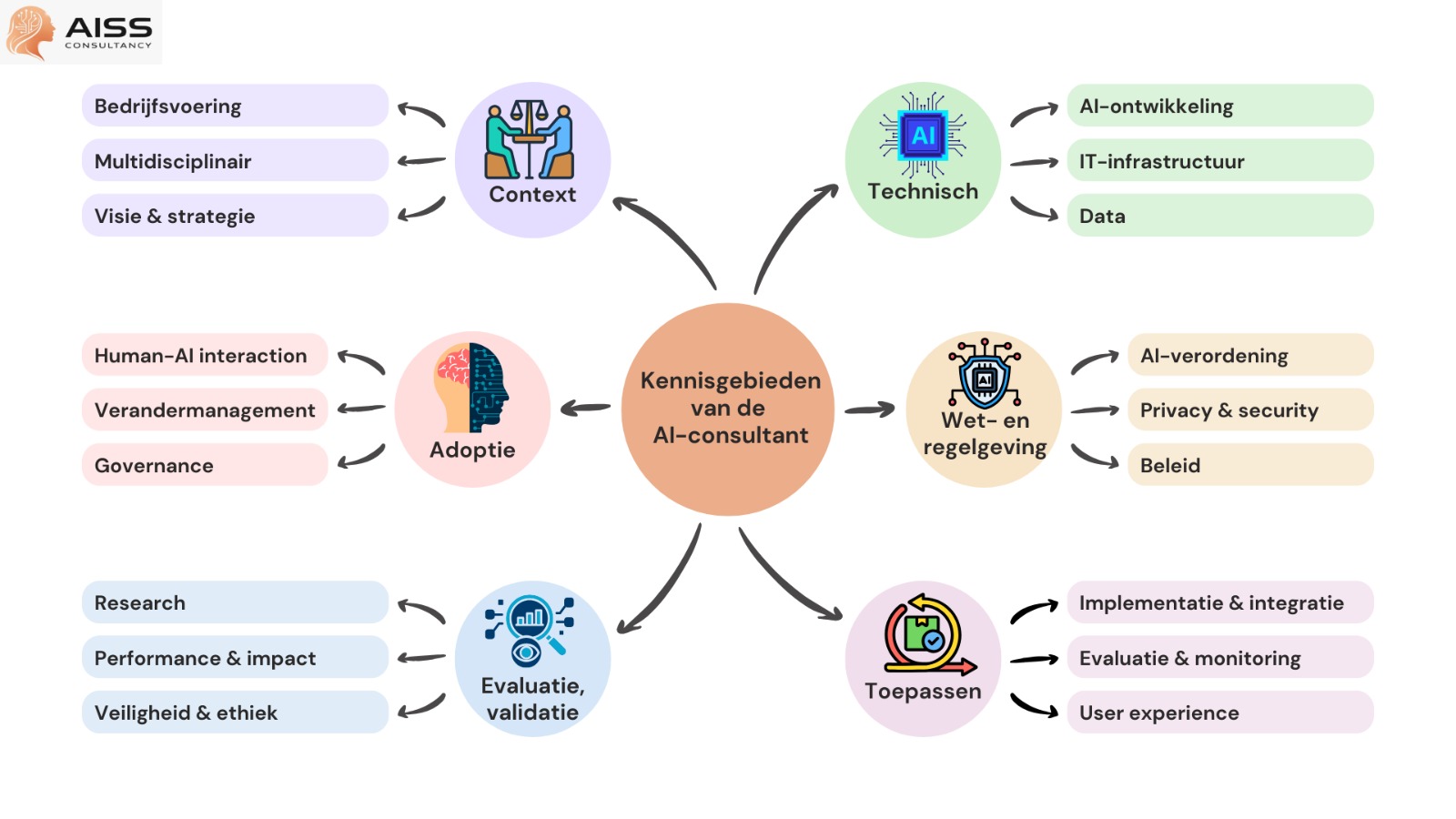
Because of its broad and specialist knowledge and expertise around AI, AISS can provide tailored support to organisations and companies across different sectors to help them move forward in the field of AI. Below are the broad topics AISS initially focuses on, from supporting selection processes and implementation to compliance and innovation. If you have an AI-related question, problem or goal that may fall outside these broad topics, you can always contact AISS for more information and to explore whether AISS can help you.
Make well-founded choices: which AI fits your goals, risks and users? We look at assessment aspects, selection criteria, transparency, and what you need to know before purchasing the AI tool.
From 'pilot' to real use: what preparations are needed, who should be involved, and how do you ensure AI fits day-to-day practice, now and in the long term?
Stay in control of performance and risks: define KPIs, evaluate holistically (such as quality, safety, bias, adoption from all relevant perspectives) and monitor continuously so you can adjust in time.
Increase knowledge and skills in your organisation to use AI responsibly and remain future-proof, while also complying with laws and regulations (such as the AI Act and GDPR).
Embed AI in policy and decision-making: agreements on ownership, transparency, privacy & security (especially the AI Act and GDPR). This makes AI manageable for your organisation and helps prevent sanctions.
Gain insight into how your organisation, department or team is currently positioned in terms of AI maturity, and where opportunities lie for performance improvements or innovation.
Self-reliance is crucial to using AI in a future-proof way. When your organisation is working on an AI project and gets stuck on elements such as setting up the required evaluation criteria for a certain type of AI, AISS can support you. Concrete tailored handouts such as checklists, self-assessments and infographics can help you make decisions, monitor progress and stay in control of AI instead of the other way around.
For AI literacy, AISS works with an approach that starts with insight (baseline assessment) and then translates this into training that fits the department, role and context. Where relevant, there is also support with:
If you would like support with a specific component of an AI project, AISS can help you with that.
In addition to the services mentioned and other forms of support, AISS can also be approached for other AI-related questions. Here are a few examples.
Start with the core problem and the intended user. Translate that into selection criteria (quality, safety, transparency, integration requirements, data, costs) and consistently assess vendors and variants against those criteria. This helps prevent 'tool-first' decisions.
Often there is insufficient alignment with workflows, ownership or adoption. Success requires preparation (processes, roles, data, training), clear agreements and an implementation process shaped together with users.
Not only technical performance matters: also look at use, workflow impact, risks, bias, safety and compliance. Work with KPIs and a fixed evaluation cadence so you can detect drift or loss of quality in time.
AI literacy is the ability of teams to understand AI, use it responsibly and recognise its limitations. Start with a baseline assessment, make training role-specific, and maintain this level through repetition and updates.
Yes, AISS can certainly help with that. In collaboration with you and all relevant perspectives, I will act as the 'linking pin' to investigate the root cause of the problem and identify possible solutions.
Define upfront what you process, why you process it, who is responsible, and how you safeguard transparency and safety. Combine this with governance agreements, documentation and monitoring, so compliance is not a separate checklist but an integrated part of the process.
Yes, AISS can help with that. Together with you and the relevant parties, I will map out the current and desired quality (performance) of the AI system and identify what is needed to close the gap between them. This is done from as many relevant perspectives as possible (holistically and sector-specifically) and with an appropriate approach.
There is a lot involved here, and the focus should mainly be on compliance with laws and regulations and on technical feasibility. It is important to assess the types of information and data collected in terms of quantity and data quality, depending on the types of model(s) and algorithm(s) used by your AI system. AISS can support and advise you in this.
Below you will find the studies conducted by Irene de Bruin, founder of AISS.
HTA-mAIx 2.0 as a Decision Support System to support the evaluation and adoption of medical artificial intelligence (AI): A mixed-method approach
de Bruin I. 2025
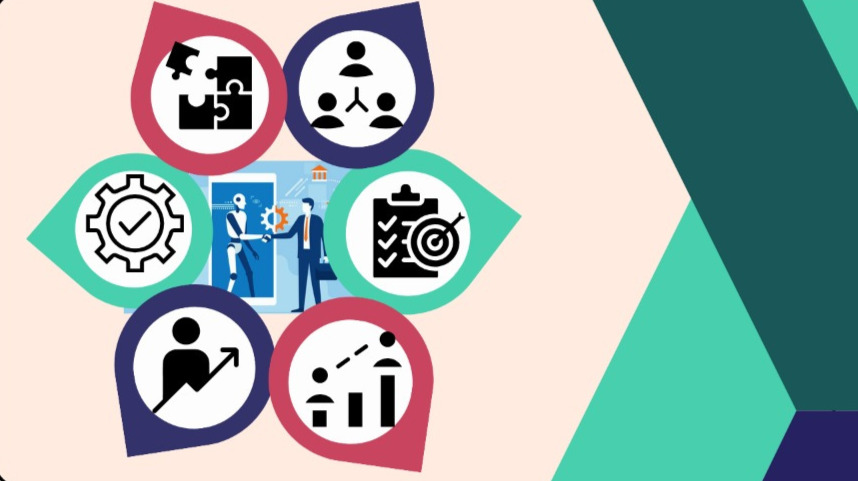
Initial steps towards a Health Technology Assessment (HTA) framework for medical Artificial Intelligence (AI): a qualitative and quantitative approach
de Bruin I. 2024
You are always welcome to get in touch about the options AISS can offer for your specific situation. This can be done via the contact form on this website, but contact by email or LinkedIn is also possible.